Plaza Real
The Shadow of the WindPlaza Real is a public square and the setting of the Barceló family’s grand apartment, where Daniel Sempere visits Clara Barceló to read The Shadow of the Wind. The square’s opulent domestic world first magnifies Daniel’s youthful fascination with Clara; later, its shadowed entrance and the surrounding storm turn it into the destination of an anxious nighttime rush. It links the private beginnings of Daniel’s attachment to Clara with the danger he associates with the book and its mysterious pursuer.
Setting and the Barceló Apartment
The apartment shared by Gustavo Barceló and his niece Clara occupies the first floor and circles the building in a ring of galleries, sitting rooms, and passageways. To Daniel, whose family home on Calle Santa Ana is modest by comparison, it resembles a miniature palace. The scale and profusion of the residence make Plaza Real a sharply different social and imaginative space from the everyday surroundings Daniel knows.
Books are only part of Gustavo’s collections: the rooms also contain statues, paintings, and altarpieces, while a gallery is crowded with foliage and tropical species. Cats and two cockatoos add to the inhabited, almost theatrical abundance of the home. For Daniel, arriving there is not simply a visit to a fellow reader; it is an entrance into a world whose luxury, collections, and cultivated atmosphere intensify his sense of Clara as exceptional.
Daniel’s Visits and His Image of Clara
After Daniel proposes visiting to read chapters of The Shadow of the Wind, Gustavo’s response is teasing rather than a refusal, and Clara settles the arrangement by inviting Daniel to come the following day around seven. The consent is conditional on Clara’s choice, making her an active participant in the visit rather than merely the object of her uncle’s arrangements.
Daniel arrives at the apartment dressed in his Sunday best and wearing cologne borrowed from his father. Bernarda, the household maid, leads him through the galleries and the densely planted conservatory before he reaches Clara in a sitting room overlooking the square. Clara is playing the piano. Daniel recognizes that her performance is technically poor, yet experiences it as beautiful: the mismatch between what he hears objectively and the celestial image he forms of her reveals how thoroughly his childhood desire shapes his perception.
The apartment’s abundance supplies the scene’s distinctive frame. Daniel moves from a familiar family home into a ring of rooms, art, books, plants, and animals, then finds Clara at the piano in a blue dress. His cologne gives him away before he can announce himself, and Clara stops playing with an embarrassed smile. The encounter combines the formality of his planned role as her reader with the self-consciousness of a boy whose admiration exceeds the ordinary purpose of the visit.
The Square as a Threshold of Danger
On a later evening, Daniel leaves the Barceló residence with Clara and Gustavo. As they walk out into Calle Canuda, Gustavo takes off his coat and places it around Clara’s shoulders. Daniel uses the moment to ask whether he may return to read to her; Gustavo laughs and warns him that he is getting ahead of himself, but his tone indicates consent. Gustavo leaves the final decision to Clara, who confirms that Daniel should come the next day and checks that he knows the address. Plaza Real thus remains the point of departure for Daniel’s visits, while Clara’s own welcome gives those visits their permission.
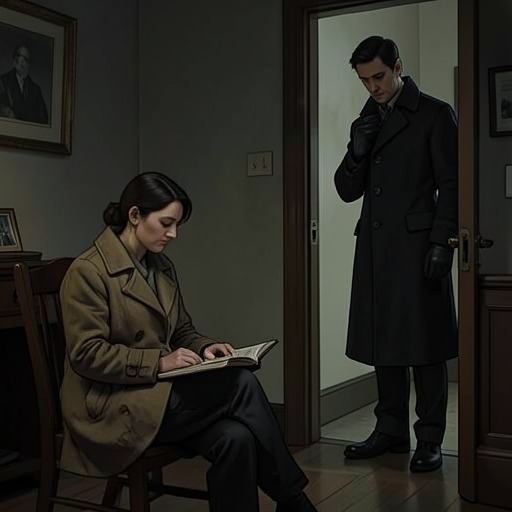
The square changes in Daniel’s imagination after he encounters a threatening, faceless stranger and learns to associate that figure with the devil in Carax’s novel. During a storm and citywide blackout, Daniel becomes increasingly afraid. He remembers that Gustavo is away on business and that Bernarda is spending the night with relatives, leaving Clara alone in the large apartment. He fears that giving her the book has placed her in danger and runs toward Plaza Real with her safety as his sole concern.
The approach is no longer a leisurely arrival for an afternoon reading. Daniel reaches the square soaked by the rain, takes shelter beneath the arches of Calle Fernando, and searches for the keys Gustavo had given him. The front door is closed; after opening it, he climbs the unlit staircase by feeling his way along the banister and walls. The transition from the open streets to the dark entrance and stairwell turns the familiar residence into a space of uncertainty. At the apartment, however, the first creatures he meets are the household cats, which recognize him and surround him before abandoning him when his wet clothes offer no warmth.
Narrative Significance
Plaza Real gathers several sides of Daniel’s early story into one location: his access to Clara, his first role as a reader in her household, and his later fear that the world of Carax’s book has crossed into her life. The apartment’s lavish interiors initially magnify the distance between Daniel’s modest home and Clara’s surroundings; the same domestic setting becomes vulnerable when its usual occupants are absent and the city outside loses its lights.
The location’s force depends on that reversal. At first, Daniel’s threshold-crossing is guided by Bernarda and animated by his romantic imagination; later, he enters alone, in darkness, driven by fear and armed only with a borrowed key. Plaza Real therefore marks not just where Daniel sees Clara, but where reading, desire, and apprehension begin to converge in his experience.